




Current Issue
Bespoke joinery in ecclesiastical and heritage buildings
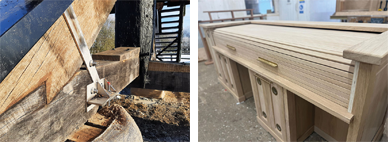 Repair of centuries old oak structural timbers using aged oak and traditional pegged joints, replacing ineffective resin repairs (left); a custom-made sound desk with a roll top lid, designed to house modern equipment within a traditional design (right)Timber can be the unsung hero in ecclesiastical and heritage buildings. From centuries-old oak doors and ornate screens, to timber windows housing magnificent stained glass, joinery shapes not only the character of a space but also how it functions and performs over time.
At Bakers of Danbury, heritage building contractors, they take great pride in their in-house joinery workshop as it allows them to design and craft bespoke pieces while preserving the history and architectural integrity of each building they work on. Here, Bakers of Danbury explores the key considerations guiding that approach.
With historic buildings rarely conforming to standard dimensions, creating bespoke joinery begins with careful assessment of style and precise measurement, so a detailed site survey is essential. Openings are measured, irregular walls and stone tracery recorded, and full-scale templates prepared to capture complex profiles such as arches, curves, joint positions and glazing details.
These templates guide the fabrication process, ensuring that every piece, from a simple frame to a complex arched door, fits precisely within the existing structure.
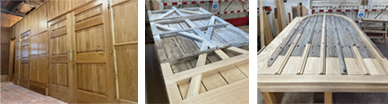 Restoration of a 500-year-old oak door using new oak timbers and limewashed to match its age with the original forged lock restored (left and centre); bespoke oak panelling designed to align with uneven stonework and arched openings, finished with oils and historically appropriate ironmongery (right)Timber selection
Choosing and understanding the timber also becomes critical. Oak has been one of the most important building materials in Britain for centuries – valued for its strength, durability and natural resistance to decay. Green oak is rich in natural moisture and is ideal for structural work and traditional timber framing. Its softness allows for shaping and chiselling, while pegged mortise and tenon joints will tighten naturally as the timber dries.
By contrast, dried oak moves very little over time which makes it ideal for cabinetry and window and door frames where precision is essential.
Replicating timber mouldings
The shift towards large-scale production has led to the loss of many traditional details, making the accurate reproduction of original timber mouldings a vital part of our work. We record original profiles using calipers, profile gauges and custom templates. These are then recreated using a combination of hand tools, such as spokeshaves and traditional moulding planes, or modern machinery depending on the complexity of the profile and the quantity required. The result is a faithful restoration that blends with the existing fabric of the building.
Traditional joinery
Traditional joinery techniques lie at the heart of our work. We use mortise and tenon joints to create strength in frames and doors; dovetail joints for durability in cabinetry; lap joints for secure panel connections; and scarf joints to extend timber or form curves. Bridle and dowel joints provide alignment and strength, while tongue and groove connections allow for natural timber movement. Each technique has its specific use and we take great pride in carrying out and maintaining and preserving these skills.
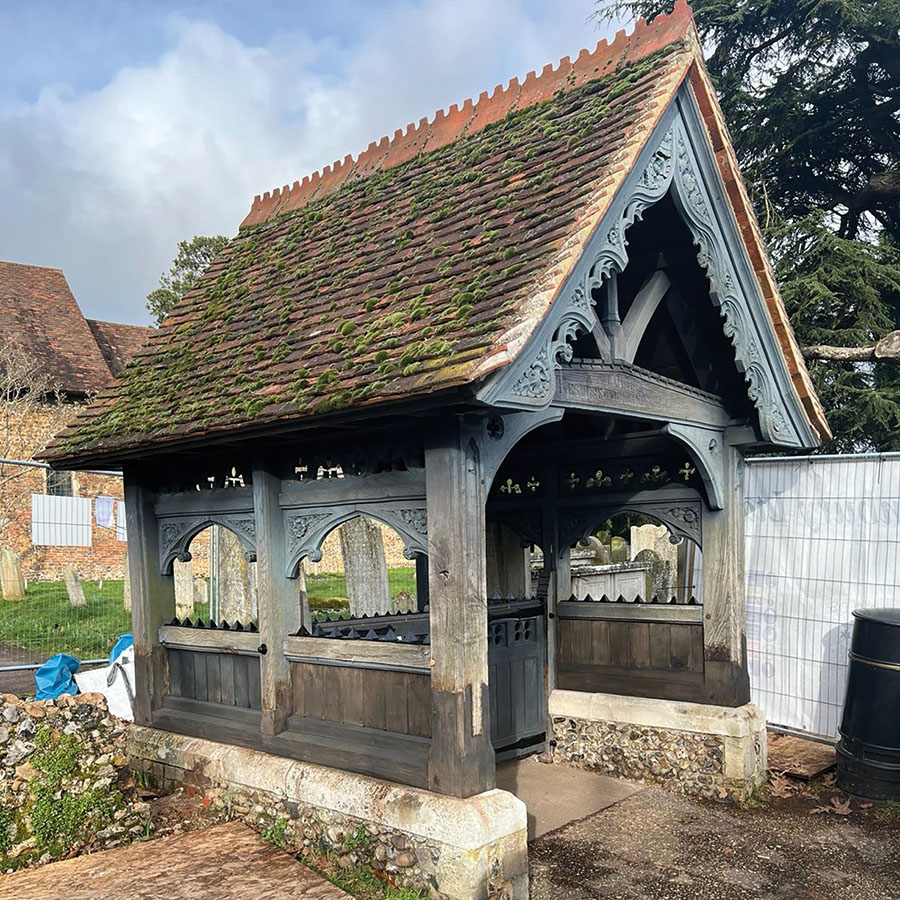 Restoration of a weathered lych gate at the church entrance replacing and repairing decayed timberConstruction of curves and arches
Curved and arched elements are a defining feature of many ecclesiastical buildings and creating them is a core part of our expertise, demanding mathematical calculation, attention to detail and practical skill. We use a segmented construction method, machining individual timber sections to specific angles so that, when assembled, they form a smooth, continuous arch. These segments are joined using strong joints – typically scarf joints reinforced with splines or loose tenons – to ensure alignment and strength. The completed arch is then integrated with straight sections using traditional joinery, before finishing and glazing, resulting in a cohesive and robust structure.The result is a carefully crafted feature that respects the building’s original character while ensuring long-term strength and stability.
Keeping history alive
Bespoke joinery plays a vital role in preserving the character and longevity of heritage buildings. At Bakers of Danbury, we rely on traditional skills, sound judgement and craftsmanship to provide joinery that is made to last and suited to its surroundings, helping to ensure these historic spaces continue to be appreciated for generations to come.
• For further information visit www.bakersofdanbury.co.uk
VISIT OUR ASSOCIATED SITES