


Current Issue
Restoration of a Victorian railway dining experience: the journey so far
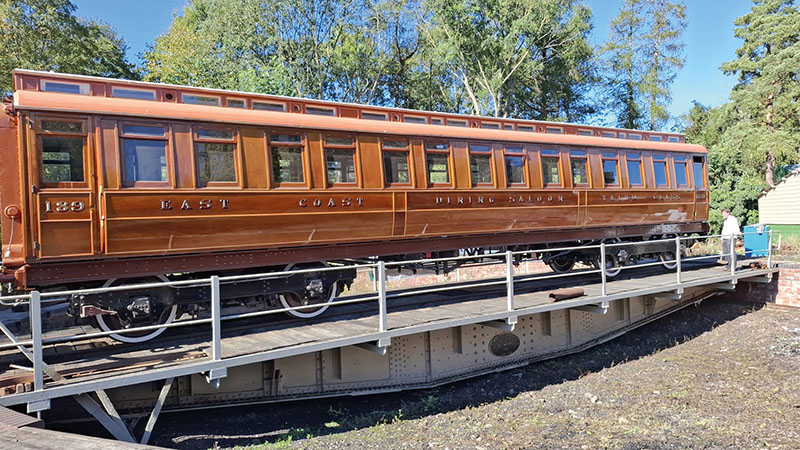 No.189 on the turntable - Photo credit Dave CullingworthFrank Holmes Fine Décor is a high-class heritage interior decorating business, founded in 1990. The company is run by husband-and-wife team Frank and Amanda Holmes and incorporates decorative artistry and traditional craftsmanship into its work.
Frank is a master wallpaper hanger. As one of the UK’s top approved Lincrusta installers and restorers Frank Holmes Fine Décor specialises in rescuing damaged heritage raised-relief wallpapers, dados, friezes and ceiling tiles, including Tynecastle, Anaglypta, Salamander and Lignomur. Frank can replicate, repair and re-finish existing installations or reproduce one-off vintage designs by commission from his extensive archive collection dating from the 1870s.
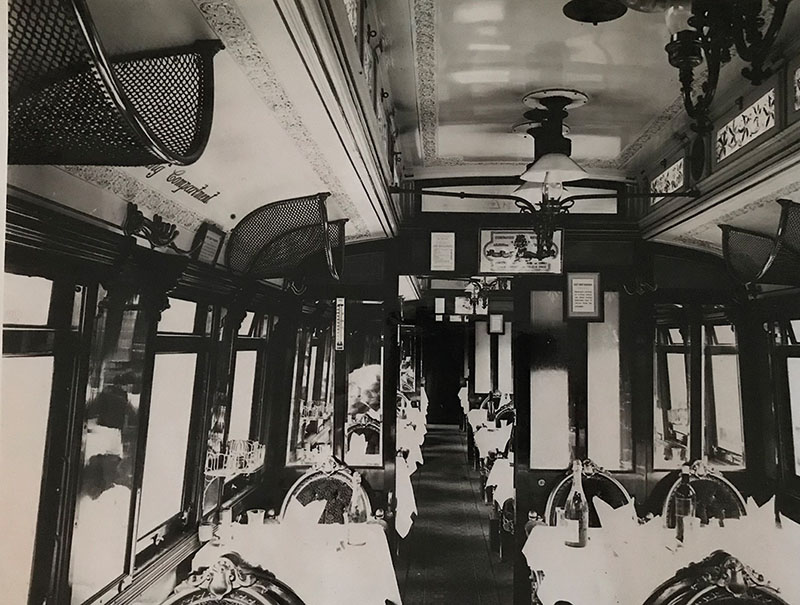 ECJS Dining Car No.189 c.1909 - Photo credit Dave CullingworthOne significant project the company has been involved with is the restoration of a Victorian railway dining carriage. The story is captivating for anybody who loves social history, Victoriana or steam train travel – fans of Bradshaw’s Guide and Michael Portillo’s BBC series Great British Railway Journeys take note!
Frank said: “Restoring Victorian dining carriage ECJS 189 has been hugely rewarding. Built in Doncaster by the Great Northern Railway Carriage works in 1894, this dining car is among the world’s oldest remaining examples. It ran on the famous ‘races to the North’ between London and Edinburgh or Aberdeen and was part of the Flying Scotsman service. In 1998 it was just one week away from being destroyed.”
Dave Cullingworth, secretary of LNER Coach Association (LNERCA), further explained its history: “East Coast Joint Stock (ECJS) was the brand name of carriages built by East Coast Railway. No. 189 was a third-class dining car with 42 seats in three saloons. Designed for a more comfortable ride, the bogie carriage is longer than the earlier four- and six-wheeled stock, with gangway connections allowing passengers to walk through the train and access toilets.”
Catering
Before dining cars, long-distance passengers had just 20 minutes at York Station for a rushed meal or they could buy snacks through carriage windows at major stops. Hardly luxurious!
Dave added: “No.189 was one of four of its type. It would have been placed next to a kitchen car (a six-wheeled carriage) and a first-class diner would lie at the other end of the kitchen car. This diner had several improvements during its 33-year operational life, especially around 1909. Claustrophobic side gangways were replaced with standard Pullman gangways. Later, electric replaced gas lighting. Also nine seats and tables in one saloon were removed, a partition was relocated and a small pantry added. We are restoring No.189 to its 1909 condition.”
On Jan 1 1923, East Coast Services was amalgamated into the London North Eastern Railway (LNER). Carriage No.189 probably became a bar car with drinks served from the pantry. After it was withdrawn from service in 1927 the carriage, built from rot-resistant teak, became a workshop on a Yorkshire farm where it remained for six decades before it was salvaged.
The role of Frank Holmes Fine Décor
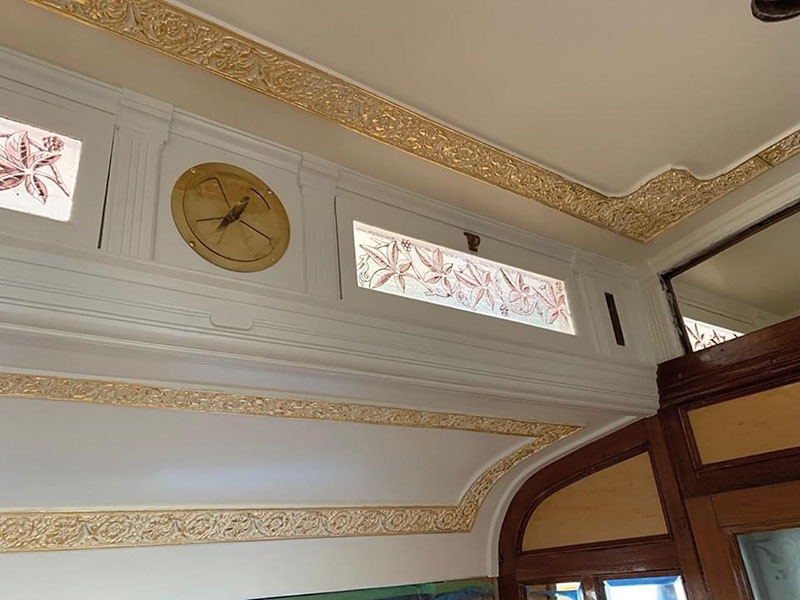
Frank continued: “The polished gold engraved wood, fine etched glass and clerestory roof make this carriage a craftsman’s delight. Part way into the restoration by the LNER Coach Association, we were delighted when we were asked to become involved, alongside conservator Helena Brazil of Lincrusta Heritage.” Lincrusta-Walton, as the company was then known, had a range of designs specifically for railway carriages.
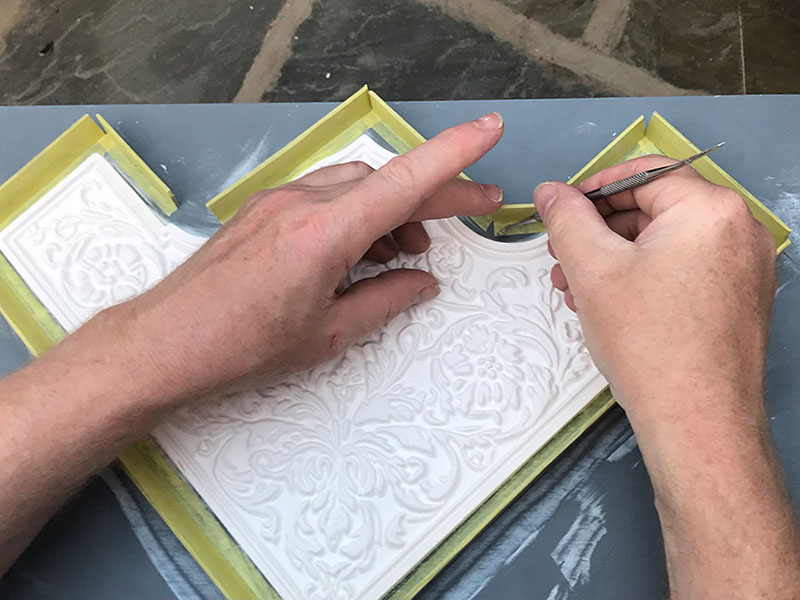
“With the original black and white photograph as the only reference, Helena first identified the Lincrusta border as one of two probable designs from the Lincrusta-Walton Catalogue for Railway Carriages. LNERCA directors chose which design to reinstate and then Helena had samples 3D-printed from the catalogue image,” Amanda explained.
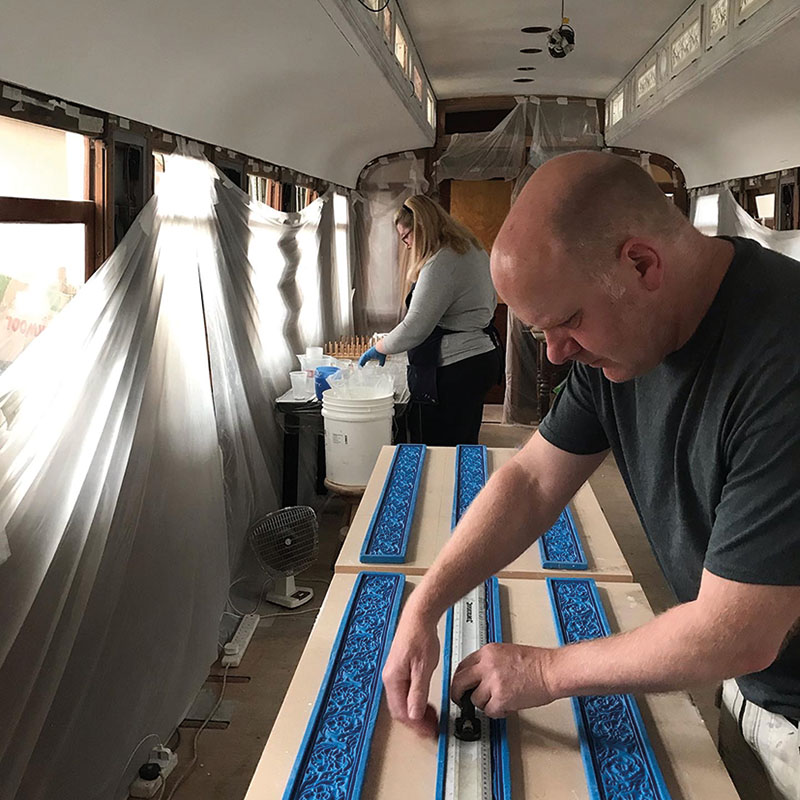
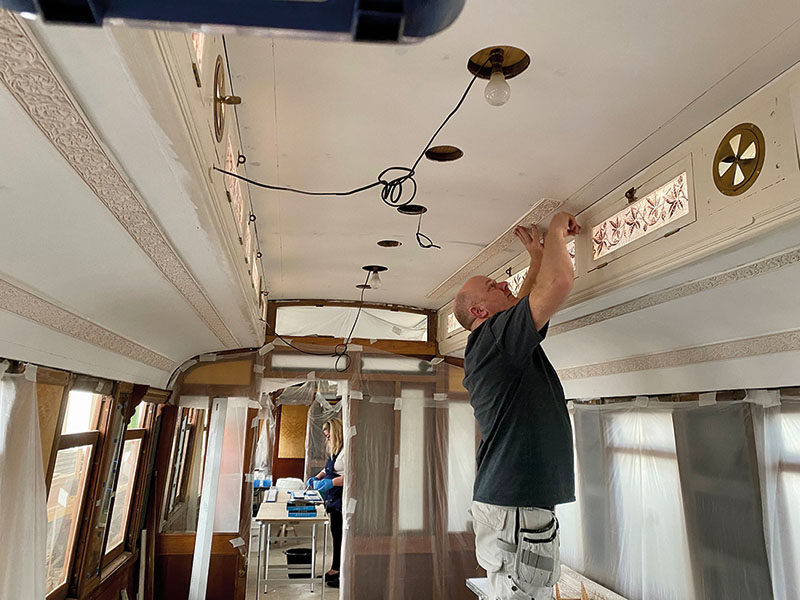
“Helena then asked Frank to ‘first cast’ and add in the fine detail by hand before recasting to make masters for mould making. After that, we spent a week in Pickering reproducing 450 feet of ‘straights’ and 12 of the corner designs on site. We then re-instated the Lincrusta borders to the Clerestory ceilings, overcoming the challenges of the curved roof.”
Continuing restoration progress
The Lincrusta now has gold leaf applied and the saloon’s teak interior has been varnished. Black lining decorates the maple panels between the windows. All the up-lights – sliding windows along the sides – have been restored, rebuilt and fitted with new latches. Numerous mirrors with bevelled glass make the carriage feel light and airy. The pantry includes a reinstalled dresser and an attendant’s bell, activated by table push buttons.
Engineer Bruce Robinson is creating replica gasoliers using LED bulbs. Without original drawings, the design relies on archive photos, CAD and 3D printing to create patterns for aluminium-cast components.There is now a more modern passenger communication cord. Today there’s an LNER system dating from the 1920s that No.189 would have received had it survived beyond 1927. Hidden speakers in the ceiling vents will allow an attendant to make announcements and give a history of the carriage to passengers as they travel.
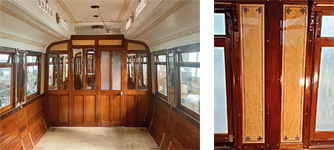 ECJS 189 interior restoration progress - Photo credit Dave CullingworthPullman gangways enable passengers to move between carriages. All four external doors have been rebuilt with new droplight springs and the latches and locks were refurbished. The carriage has received eight coats of varnish and is fully lined and lettered. ECJS crests will also be added.
“ECJS dining car No.189 is slowly returning to its 1909 condition and we continue to follow the restoration journey. Working on such an interesting project may be a once in a lifetime opportunity for us at Frank Holmes Fine Décor. We’re proud to have played a role,” said Frank.
About the LNER Coach Association
Founded in 1979, LNERCA is a volunteer-run charity preserving carriages from the former LNER and its predecessors, with vehicles dating from 1890 to 1950. Restoration projects, each costing at least £50,000, are funded by memberships, donations, bequests and grants. New members and volunteers are always welcome and can get in touch at www.lnerca.org.
For further information visit www.frankholmesltd.com
VISIT OUR ASSOCIATED SITES